For both sides
Buying or selling a cannabis business in Colorado
Federal and state law current as of September 2026 — verify with counsel.
Colorado cannabis licences are not sold like property. The business keeps its licence and the Marijuana Enforcement Division must approve each new controlling beneficial owner before closing, with local licensing approval required before the state makes it final. The state does not cap licences, sales fell to about $1.3 billion in 2025, and wholesale flower hit a record low, so buyers pay for cash flow and location.
Key takeaways
- A non-public Colorado marijuana business needs Marijuana Enforcement Division approval before any controlling beneficial owner's interest is transferred, under 1 CCR 212-3, Rule 2-245.
- State contingent approval of a change of owner lasts one year while the local licensing authority decides.
- Colorado marijuana sales were about $1.3 billion in 2025, roughly 40% below the 2021 peak of $2.2 billion, and active recreational cultivation licences fell from about 800 in 2022 to 487.
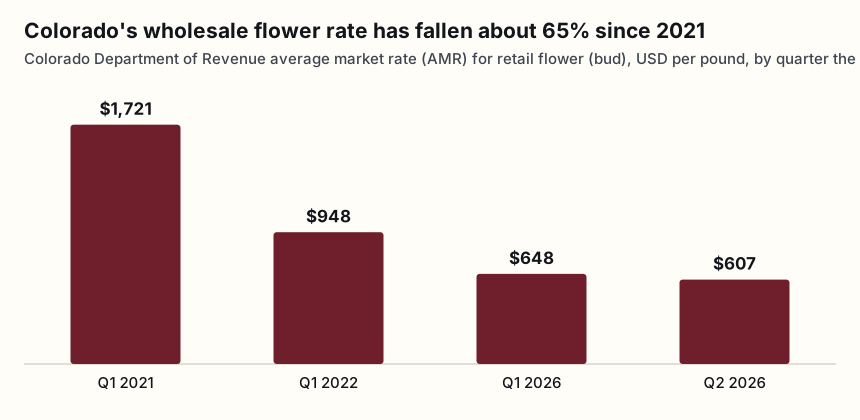
- The state's average market rate for wholesale flower was $648 a pound at the start of 2026, against a 2021 peak of $1,721.
- Colorado has let licensed marijuana businesses deduct 280E-disallowed expenses on the state return since tax year 2014.
Legal status and regulator
Colorado licenses both medical and retail (adult-use) marijuana. The Marijuana Enforcement Division (MED), part of the Department of Revenue, is the state licensing authority. Its rules sit in 1 CCR 212-3. Every business also answers to a local licensing authority, which is the city or county where the premises sit.
Licence classes cover stores, cultivation facilities, products manufacturers, testing facilities, transporters, business operators, delivery permits, and hospitality businesses. Most are issued in separate medical and retail versions, and many sites hold both.
Are Colorado licences capped?
Not by the state. Colorado licenses every qualified applicant, which makes it an open-market state. The limits that matter are local. Cities and counties may ban marijuana businesses, cap store counts, or restrict locations by zoning and buffers. Denver, for example, reserves most new licences for social equity applicants until 1 July 2027 and blocks new stores in its most saturated neighbourhoods. A state licence carries little standalone value. A lawful location in a restricted town does.
How a sale works in Colorado
Colorado uses ownership-change approval. The licence stays with the entity and the regulator approves the new people behind it.
- Trigger. A business that is not publicly traded must get MED approval before transferring any controlling beneficial owner’s interest, under Rule 2-245. Control can come from management rights as well as equity.
- Forms. The current licence holders file the Change of Controlling Beneficial Owner application, form DR 8535. Each incoming owner files for a finding of suitability, with fingerprints. Fees follow the MED fee table and are non-refundable.
- Local approval. The state issues a contingent approval that is valid for one year. Final state approval waits until any required local approval is shown.
- Asset deals. A buyer who wants only the assets still ends up in the same file, because the licence cannot operate under new owners without the change of owner approval, and a move of premises needs separate state and local consent. See relocating a licence.
- Lenders and investors. A person who provides debt above 50% of operating capital, or holds two or more indirect financial interests, must be disclosed under Rule 2-230. That can catch a seller note. See true party of interest rules.
The buyer may not take control before approval. Deals are usually signed with approval as a closing condition, as described in regulatory-approval contingencies.
Residency, ownership limits, and social equity
Colorado has no residency requirement for owners. It admitted publicly traded companies and outside investors in 2019, and HB20-1080 then removed the residency rule. The state does not cap how many licences one owner may hold.
The state runs a social equity licensee designation and an accelerator programme. The transfer restrictions that bite are local. In Denver, a licence issued under social equity exclusivity must stay at least 51% owned by social equity applicants when it is transferred. Check the local code before pricing any licence issued after 2021. General background is in social equity licence transfer restrictions.
Taxes and 280E
| Tax | Rate | Source |
|---|---|---|
| Retail marijuana sales tax | 15% of retail price | Colorado DOR |
| Retail marijuana excise tax | 15% on the first transfer from a cultivation, on the average market rate or contract price | Colorado DOR |
| Medical marijuana | 2.9% state sales tax, no retail marijuana taxes | Colorado DOR |
| Local | City and county sales taxes and special marijuana taxes vary | Local codes |
Integrated operators pay the excise on the state’s published average market rate, not on their real cost. When the published rate sits above the price a grower could actually get, the integrated operator overpays relative to an independent.
Colorado was the first state to decouple from 280E. Licensed businesses have subtracted the disallowed expenses on the state return for tax years from 2014 under C.R.S. 39-22-104(4)(r) and 39-22-304(3)(m). Federal 280E still applies to retail marijuana. Dual medical and retail sites now need an apportionment method for the medical share that moved to Schedule III in April 2026.
Track-and-trace
Colorado uses Metrc. A buyer can test years of reported sales and inventory against the books, as covered in verifying revenue with track-and-trace data.
Market conditions in 2026
Colorado is a mature market that is shrinking.
- Sales were about $1.3 billion in 2025, down about 40% from the $2.2 billion peak in 2021. The Department of Revenue reported more than $236 million of marijuana tax and fee revenue for 2025.
- Active recreational cultivation licences fell from about 800 in 2022 to 487 at the end of 2025, according to the same Bisnow report.
- Monthly sales in 2026 have run near $100 million. May 2026 sales were $107.5 million, and state tax and fee revenue for the first half of 2026 was about $113.9 million.
- The state’s average market rate for wholesale flower was $648 a pound at the start of 2026, a record low, compared with $1,721 in 2021.
- Stress shows in the licence file. CRB Monitor reported in April 2026 that more than 200 licences had missed fee payments over six months.
What this means for sellers
Expect buyers to price on trailing earnings and to discount declining sales. A store with stable revenue in a town that limits locations is still saleable. A standalone wholesale grow competes with failing operators who are liquidating equipment, so cost per pound and contracted offtake decide whether it sells as a business or as assets. Clean up MED fee arrears, local licence renewals, and ownership disclosures before going to market. The approach is set out in selling in an oversupplied market.
What this means for buyers
Colorado is cheap to enter and hard to grow in. There is no state scarcity premium, so do not pay for one. Pay for a protected location, a lease that survives the sale, and earnings that hold after a realistic price deck. Confirm the local authority’s transfer rules first, because the local file often takes longer than the state’s. Most buyers here are existing Colorado operators consolidating stores. An intro call can cover whether a specific target is worth a letter of intent.
Is a broker licence required?
Trade sources list Colorado among the states that require a real estate licence for business brokerage in at least some transactions. The position depends on whether real property is part of the deal. See business broker licensing by state.
This page is educational and is not legal or tax advice.
Frequently asked questions
Can an out-of-state buyer own a Colorado marijuana business?
Yes. Colorado opened its market to outside investors and publicly traded companies in 2019 and its legislature then removed the old residency requirement for owners. Every controlling beneficial owner still needs a finding of suitability from the Marijuana Enforcement Division, which involves fingerprints and a background review, before an ownership change is approved.
Is a Colorado dispensary licence worth anything by itself?
Not much at state level, because Colorado does not cap the number of licences. Value comes from the local side. A store in a city that caps locations, bans new stores, or restricts them by buffer and neighbourhood rules has a position a newcomer cannot copy. Buyers pay for that location plus verified earnings, not for the state licence.
How long does a Colorado change of ownership take?
There is no single published deadline. The state issues a contingent approval that stays valid for one year while the local licensing authority reviews the change, and final state approval follows local approval. Sellers should plan for several months and build the purchase agreement around both approvals.
Do Colorado medical marijuana businesses still face 280E?
Federal law changed for state-licensed medical activity when it moved to Schedule III in April 2026. Retail, meaning adult-use, marijuana remains Schedule I and subject to 280E. Many Colorado stores hold both medical and retail licences at one address, so they must apportion. Colorado's own income tax has ignored 280E since 2014.
Why are so many Colorado grows closing?
Wholesale prices. The state's average market rate for flower fell to a record low of 648 dollars a pound at the start of 2026, from 1,721 dollars in 2021, while statewide sales fell from 2.2 billion dollars in 2021 to about 1.3 billion dollars in 2025. Growers without low unit costs or a captive retail outlet struggle to cover fixed costs.
Sources
- Code of Colorado Regulations — 1 CCR 212-3, Rule 2-245, Change of Controlling Beneficial Owner — https://www.law.cornell.edu/regulations/colorado/1-CCR-212-3-2-245
- Code of Colorado Regulations — 1 CCR 212-3, Rule 2-230 — https://www.law.cornell.edu/regulations/colorado/1-CCR-212-3-2-230
- Colorado Marijuana Enforcement Division — Change of Controlling Beneficial Owner application, DR 8535 (May 2025) — https://med.colorado.gov/sites/med/files/documents/DR%208535e%20COO%205-2025.pdf
- Colorado Marijuana Enforcement Division — Licenses and Fees — https://med.colorado.gov/licenses-and-fees
- Bisnow — Smaller Denver Cannabis Growers Closing, Freeing Up Warehouses (1 April 2026) — https://www.bisnow.com/denver/news/cannabis/smaller-denver-cannabis-growers-closing-freeing-industrial-space-133954
- Colorado Department of Revenue — Marijuana sales generate over $236M in tax and fee revenue for 2025 — https://tax.colorado.gov/press-release/marijuana-sales-generate-over-236m-in-tax-fee-revenue-figures-for-2025
- Colorado Department of Revenue — Marijuana sales generate more than $18M in revenue in June (2026) — https://tax.colorado.gov/press-release/marijuana-sales-generate-more-than-18m-in-revenue-in-june
- Colorado Department of Revenue — Marijuana excise tax — https://tax.colorado.gov/marijuana-excise-tax
- Colorado Department of Revenue — Marijuana sales tax — https://tax.colorado.gov/marijuana-sales-tax
- BizWest — Colorado pot prices hit record low (4 January 2026) — https://bizwest.com/2026/01/04/colorado-pot-prices-hit-record-low/
- Justia — C.R.S. 39-22-104 (2024) — https://law.justia.com/codes/colorado/title-39/specific-taxes/income-tax/article-22/part-1/section-39-22-104/
- Colorado General Assembly — HB20-1080, Remove Residency Requirement For Marijuana License — https://leg.colorado.gov/bills/HB20-1080
- CRB Monitor — Delinquent Licensing Fees Lead to New Fines in CO (April 2026) — https://news.crbmonitor.com/2026/04/delinquent-licensing-fees-lead-to-new-fines-in-co/