For buyers
Is a cannabis business a good investment?
Federal and state law current as of September 2026 — verify with counsel.
A cannabis business can be a good investment, but most are not. In Whitney Economics' June 2024 survey only 27.3% of U.S. operators were profitable, against roughly 65% of small businesses generally. Returns exist where licences are scarce, prices are stable, the purchase price reflects after-280E cash flow, and the buyer can fund the deal without bank debt.
Key takeaways
- Whitney Economics found 27.3% of U.S. cannabis operators profitable, 40.6% breaking even, and 32.2% losing money in its June 2024 survey.
- Adult-use operators remain subject to IRC 280E, which taxes gross profit rather than net income; qualifying state-licensed medical activity moved to Schedule III on 28 April 2026.
- Whitney Economics reported mature-market prices falling 10 to 20% a year and 24 states with declining revenue in 2025.
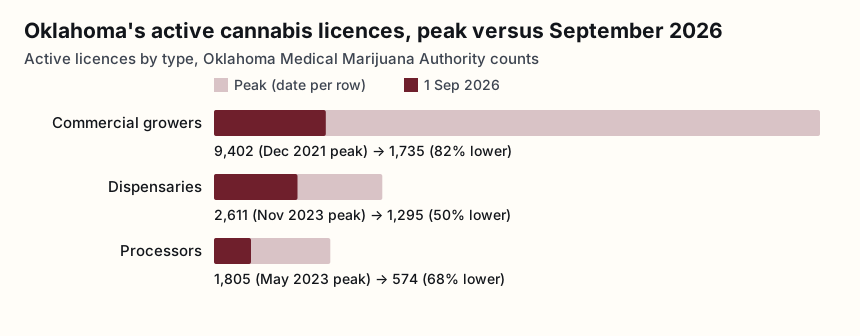
- Oklahoma's active grower licences fell from a peak of 9,402 in December 2021 to 1,735 on 1 September 2026.
- Scarce-licence markets and distressed purchases at low prices are where buyers most often find a defensible return.
What the profitability data says
Most licensed cannabis businesses do not make money. In its June 2024 survey of licensed operators, Whitney Economics found 27.3% profitable, 40.6% breaking even, and 32.2% not profitable. The same release put the comparable figure for all U.S. small businesses at 65.3%.
The trend matters as much as the level. The firm reported 42.4% of operators profitable in 2022, 24.6% in 2023, and 27.3% in 2024. The share only breaking even doubled over that period, from 20.3% to 40.6%. Its earlier survey report listed the causes operators named: falling prices against rising costs, tax and regulatory burden, and no access to normal capital.
These are self-reported survey answers, not audited results. Treat them as a base rate. If roughly one operator in four is profitable, your diligence has to show why the target is in that quarter and will stay there under your ownership.
Why is it so hard to make money in cannabis?
Four structural problems explain most of the gap between cannabis and ordinary small business.
Section 280E taxes gross profit, not net income
IRC 280E disallows deductions and credits for a business trafficking in a Schedule I or II substance. Cost of goods sold still reduces taxable income; rent, payroll, marketing, and other operating costs do not. The April 2026 federal rule moved FDA-approved products and marijuana under a state medical licence to Schedule III, so qualifying medical activity is outside 280E going forward. Adult-use marijuana is still Schedule I. Adult-use operators still pay tax this way, and dual-licence operators must apportion.
Illustrative example, adult-use retailer, 21% federal corporate rate:
| Line | Ordinary business | Under 280E |
|---|---|---|
| Revenue | $4,000,000 | $4,000,000 |
| Cost of goods sold | $2,000,000 | $2,000,000 |
| Gross profit | $2,000,000 | $2,000,000 |
| Operating expenses | $1,400,000 | $1,400,000 (not deductible) |
| Pre-tax income | $600,000 | $600,000 |
| Federal taxable income | $600,000 | $2,000,000 |
| Federal tax at 21% | $126,000 | $420,000 |
| Cash after federal tax | $474,000 | $180,000 |
Same store, same sales, 62% less cash. The effective federal rate on real income is 70%. Whitney Economics cited operators facing effective rates of 52.5% in the 2024 release above. The mechanics are covered in 280E explained for buyers and sellers, and the pricing consequence in how 280E affects valuation.
Prices keep falling in open markets
Whitney Economics told Shanken News Daily in July 2026 that prices in maturing markets have been dropping 10 to 20% a year, that Arizona prices are down about 35% since adult-use sales began in 2021, and that U.S. cannabis stocks sit at roughly six times demand. The same analysis counted 24 states with declining cannabis revenue in 2025 and 15 with growth. In 2020 the split was 5 declining and 30 growing.
A buyer underwriting flat prices in an uncapped state is underwriting against the record. See how oversupply and price compression affect value for how this flows into price.
Operators are exiting
Licence counts show the attrition. Oklahoma’s regulator reports 1,735 active growers on 1 September 2026, down from a peak of 9,402 in December 2021. Dispensaries fell from 2,611 (November 2023) to 1,295, and processors from 1,805 (May 2023) to 574. Some of that is enforcement against illegal operators. Much of it is businesses that could not cover costs.
Capital is scarce and failure is messy
Marijuana businesses cannot get SBA 7(a) or 504 loans, and the SAFE Banking Act of 2026 has been introduced but not enacted. Acquisition debt, where it exists, comes from private lenders at higher rates; see cannabis acquisition financing options. Plant-touching businesses also generally cannot use federal bankruptcy, so a failed investment is resolved through state receivership or a wind-down, which recovers less for equity.
Where do returns actually exist?
Returns concentrate in a few situations. None is guaranteed, and each has its own way of going wrong.
- Scarce-licence markets. Where the state or the city has stopped issuing licences, existing holders face fewer new competitors. Washington’s Liquor and Cannabis Board, for example, is not accepting new retailer, producer, or processor applications outside its social equity program. The trade-off is a higher entry price. The comparison is laid out in limited-licence vs open-market states.
- Medical and dual-licence operators after the 2026 rule. A business with qualifying medical activity may now deduct ordinary expenses against that activity. The benefit depends on the medical share of sales and on how the IRS treats apportionment, so model it as a separate case, not as the base case.
- Low-cost producers. In an oversupplied wholesale market the last survivors are the growers with the lowest cost per pound. Compare the target against the figures in cannabis benchmarks.
- Distressed purchases. When operators exit, licences, equipment, and leases change hands below replacement cost. The price is low because the risk is real: unpaid taxes, compliance history, and deferred maintenance. Start with valuing a distressed cannabis business.
- Well-located retail with local protection. A store inside a municipal cap or a tight zoning envelope has a moat that state law alone does not provide.
How to test whether a specific deal is a good investment
Ask five questions before you look at anything else.
| Question | What a good answer looks like |
|---|---|
| What is cash flow after 280E and state excise tax? | Seller’s numbers reconcile to filed returns, and the price is based on after-tax cash, not pre-tax EBITDA |
| What happens if prices fall another 15%? | The business still covers debt service and rent |
| How many more licences can the state or city issue? | A cap, a moratorium, or a local limit you can cite |
| Can the licence legally move to you? | A clear change-of-ownership path and an owner group that qualifies |
| How will you pay for it? | Committed cash, seller note, or private credit on terms the cash flow supports |
The full process is in how to evaluate a cannabis business for sale. If you would rather own the economics without the licence risk, compare plant-touching vs ancillary investment.
A realistic way to think about it
Cannabis is not a growth story you can buy at any price. It is a regulated, cash-heavy, heavily taxed consumer business where the median operator breaks even. Buyers who do well pay for demonstrated after-tax cash flow, in a market with a limit on new supply, with capital that does not force a sale at the first price dip. Everything on this page is general education, not investment, tax, or legal advice, and nothing here predicts the result of any particular purchase.
Frequently asked questions
What percentage of cannabis businesses actually make money?
In Whitney Economics' June 2024 business conditions survey, 27.3% of U.S. cannabis operators said they were profitable, 40.6% were breaking even, and 32.2% were not profitable. The same firm reported 42.4% profitable in 2022 and 24.6% in 2023. These are self-reported survey results from licensed operators, not audited figures, but the direction has been consistent.
Does rescheduling make cannabis a better investment?
Partly. The April 2026 federal rule moved FDA-approved products and marijuana under a state medical licence to Schedule III, which takes qualifying medical activity out of section 280E going forward. Adult-use marijuana is still Schedule I, so adult-use operators still lose their operating deductions. A dual-licence business has to apportion, and buyers should model both cases.
Are dispensaries or cultivation businesses the safer investment?
Neither is safe by category. Retail tends to have steadier margins because it is protected by local caps and zoning, but it carries the heaviest 280E burden in adult-use states. Cultivation is more exposed to wholesale price swings and oversupply. The market, the licence count, and the purchase price matter more than the licence type.
Can I use an SBA loan or a bank loan to invest in a cannabis business?
No SBA loan. Marijuana-related businesses are ineligible for SBA 7(a) and 504 lending under the agency's current operating procedures, and most commercial banks will not lend against a plant-touching business. Buyers typically rely on cash, seller notes, private credit, and investor equity, all of which cost more than conventional debt.
Why do cannabis businesses fail if demand keeps growing?
Demand growth has not kept up with supply in open-licence states. Falling wholesale and retail prices, a federal tax rule that disallows ordinary deductions for adult-use operators, high state excise taxes, expensive capital, and no access to federal bankruptcy protection combine to squeeze operators who are not low-cost or protected by licence scarcity.
Sources
- Whitney Economics (PR Newswire) — Cannabis Business Conditions Survey results indicate only 27.3% of U.S. cannabis operators are profitable (2024) — https://www.prnewswire.com/news-releases/whitney-economics-cannabis-business-conditions-survey-results-indicate-only-27-3-of-us-cannabis-operators-are-profitable-302204870.html
- Shanken News Daily — Price Compression Predictable And Inevitable, Whitney Says (14 July 2026) — https://www.shankennewsdaily.com/2026/07/14/40217/price-compression-predictable-and-inevitable-whitney-says/
- Whitney Economics — Survey Report Shows U.S. Cannabis Industry in Crisis (2023) — https://whitneyeconomics.com/blog/survey-report-shows-us-cannabis-industry-in-crisis
- Oklahoma Medical Marijuana Authority — Licensing and Tax Data (1 September 2026) — https://oklahoma.gov/omma/about/licensing-and-tax-data.html
- Cornell Legal Information Institute — 26 U.S.C. 280E — https://www.law.cornell.edu/uscode/text/26/280E
- Federal Register — Document 2026-08176, rescheduling of FDA-approved and state medical marijuana (28 April 2026) — https://www.federalregister.gov/d/2026-08176
- Congress.gov — S.4942, SAFE Banking Act of 2026 (introduced 24 June 2026) — https://www.congress.gov/bill/119th-congress/senate-bill/4942
- Washington State Liquor and Cannabis Board — Cannabis Licensing (2026) — https://lcb.wa.gov/cannabis-license/cannabis-licensing