For both sides
How oversupply and price compression affect value
Federal and state law current as of September 2026 — verify with counsel.
Oversupply lowers cannabis business value twice. Falling wholesale and retail prices shrink earnings, and buyers then apply a lower multiple to those smaller earnings because they expect more compression. Colorado's state-set wholesale flower rate fell from $1,721 per pound in early 2021 to $607 in the second quarter of 2026. Cultivators absorb the hit first; retailers feel it through smaller baskets and thinner gross margin dollars.
Key takeaways
- Colorado's average market rate for retail flower fell from $1,721 per pound (January to March 2021) to $607 per pound (April to June 2026), about a 65% decline, per the Department of Revenue.
- Michigan's average adult-use flower price fell from $419 per ounce in 2020 to $60.33 per ounce in August 2026, per Cannabis Regulatory Agency data.
- For a grower with costs of $650 per pound, a price drop from $1,000 to $700 cuts margin per pound from $350 to $50, an 86% fall in earnings on a 30% fall in price (illustrative).
- Buyers in compressed markets value on current run-rate or forward earnings at today's prices, not a three-year average that includes higher-price years.
- When earnings approach zero, value falls to an asset floor: equipment, real estate, inventory at current wholesale, and whatever the licence is worth in that state.
How far have cannabis prices fallen? State price series
Prices in mature, open-licensing states have fallen by half to more than 80% from their peaks. The series below come from state agencies or from trade press reporting agency data. Each is a different measure, so compare a state with its own history, not with another state.
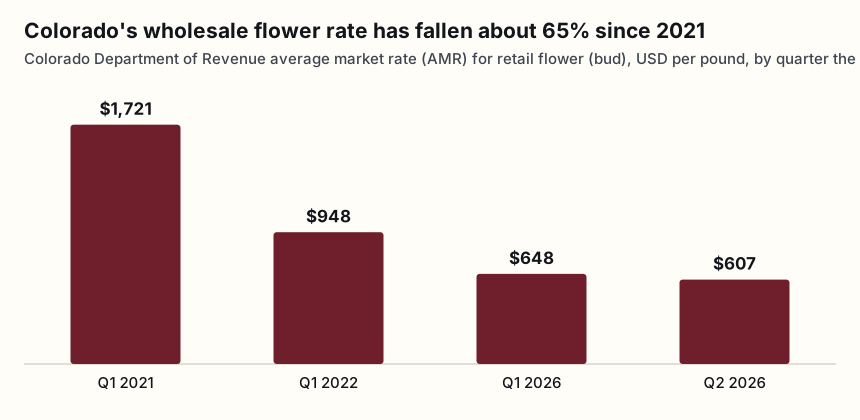
Colorado: state-set wholesale rate per pound
Colorado’s Department of Revenue publishes a quarterly average market rate (AMR), the median price of unaffiliated wholesale transfers, used to set excise tax. It is the closest thing to an official wholesale price series in the country. See the Colorado state page for the market structure.
| Quarter the rate applied | Retail flower (bud) AMR per pound | Source |
|---|---|---|
| January to March 2021 | $1,721 | Colorado DOR AMR notice, January 2021 |
| January to March 2022 | $948 | Colorado DOR figures reported by KRDO, 14 December 2021 |
| January to March 2026 | $648 | Colorado DOR AMR release, 2026 |
| April to June 2026 | $607 | Colorado DOR AMR release, effective 1 April 2026 |
From $1,721 to $607 is a decline of about 65% in five years. Trim fell with it: the AMR for trim was $354 per pound for the first quarter of 2022, per the same KRDO report.
Michigan: average adult-use retail flower price per ounce
Michigan has no state cap on licences, and the Cannabis Regulatory Agency (CRA) publishes average retail prices monthly. See the Michigan state page.
| Period | Average adult-use flower price per ounce | Source |
|---|---|---|
| 2020 (annual average) | $419 | CRA data via Cannabis Business Times |
| 2024 (annual average) | $83.71 | Same |
| February 2025 | $65.21 | CRA data via Cannabis Business Times, 2026 |
| February 2026 | $59.85 | Same |
| April 2026 | $59.05 | CRA April 2026 report |
| June 2026 | $58.18 | CRA June 2026 report |
| August 2026 | $60.33 | CRA August 2026 report |
That is a fall of about 86% from the 2020 average. Supply did not leave: as of 31 August 2026 Michigan still had 803 active Class C grower licences and 845 adult-use retailers, per CRA figures.
Oregon and Massachusetts
- Oregon. The median retail price of usable marijuana was $3.33 per gram in December 2025, while growers harvested more than 13 million pounds in 2025, up from just over 12 million in 2024, and sales fell 3.5% to $925 million, according to OLCC figures reported by OPB. Sales peaked near $1.2 billion in 2021. The underlying series are on the OLCC market data page. More on the Oregon state page.
- Massachusetts. The average retail price hit a record low of $3.81 per gram, or $108.01 per ounce, for August 2026 in Cannabis Control Commission data. Massachusetts shows that compression reaches newer East Coast markets too, just later.
National reference point
The Cannabis Benchmarks U.S. Spot Index was $1,088 per pound on 4 September 2026, with an October 2026 implied forward of $1,110. A national average hides a wide spread between limited-licence states and oversupplied ones. For valuation work, use the state series, and where possible the seller’s own realized prices from track-and-trace data.
How does a price decline flow through to value?
Price cuts hit earnings with leverage, because most cultivation and retail costs are fixed in the short run. A modest percentage fall in price can erase most of the profit.
Illustrative: a cultivator with $650 per pound cash cost
Illustrative arithmetic only. Not an appraisal and not a forecast of any state’s prices.
| Wholesale price per pound | Margin per pound | EBITDA on 4,000 pounds | Value at 3x EBITDA |
|---|---|---|---|
| $1,000 | $350 | $1,400,000 | $4,200,000 |
| $850 | $200 | $800,000 | $2,400,000 |
| $700 | $50 | $200,000 | $600,000 |
| $600 | minus $50 | minus $200,000 | Asset value only |
A 30% price decline, from $1,000 to $700, cuts EBITDA by 86%. At $600, close to Colorado’s second-quarter 2026 AMR, this grower loses money on every pound and an earnings multiple no longer produces a number. Cost per pound is therefore the first figure a buyer checks; the cost-per-pound calculator shows how to build it.
The second hit: a lower multiple
Compression also changes the multiple. A buyer who expects prices to keep sliding treats current earnings as a peak, not a base. Trade commentary puts single-store dispensaries at roughly 3x to 6x normalized EBITDA as of February 2026 (Collateral Base; commentary, not a survey), and brokers generally see oversupplied-market deals at the bottom of such ranges or below. Cultivation in an oversupplied state usually prices lower than retail in the same state. Method differences by licence class are in cultivation valuation per square foot and per pound.
Which earnings period should a valuation use when prices are falling?
Use the period that reflects today’s prices. In a falling market that is the trailing twelve months at most, and often the latest quarter annualized.
A practical approach:
- Restate the last 12 months of volume at current realized prices, not the prices actually received nine months ago.
- Reprice inventory at current wholesale. Biomass booked at last year’s cost may be worth less than book; see inventory and biomass at closing.
- Separate contracted or branded sales from spot sales. Contracted volume at fixed prices deserves more weight.
- Run a downside case at a further 10% to 20% price decline and see whether the business still covers fixed costs.
- Present older, higher-price years as history only.
Who holds value in an oversupplied state?
Value concentrates in operators with a durable advantage that compression does not erase:
- Lowest-cost producers. When price converges toward the marginal grower’s cash cost, only growers below that cost earn anything.
- Retailers in locally capped cities. State licensing may be open while the city permits only a few stores. Local scarcity protects traffic. See license value in capped vs uncapped states.
- Brands with retail pull-through and vertical operators that capture the retail margin on their own flower.
- Owners of the real estate, whose value does not depend on the wholesale price.
Everyone else tends toward the asset floor: equipment at resale value, inventory at current wholesale, real estate, and a licence worth little where new ones are available. When earnings are negative and creditors are pressing, the analysis shifts to valuing a distressed cannabis business.
What sellers can do about it
You cannot fix the market price. You can fix how your numbers read.
- Show cost per pound or margin per transaction by month, so a buyer sees you tracking the right thing.
- Document any cost reductions already made, with the months they took effect.
- Lock in what can be locked: supply agreements, lease extensions, key staff.
- Price the business on current earnings. Listings anchored to 2021 numbers sit unsold.
Deal structure also adapts to compression, with more seller notes and earn-outs; see selling in an oversupplied cannabis market for the sale-process side. This page is general education, not financial or legal advice, and the ranges cited are reported commentary rather than appraisals.
Frequently asked questions
Why did my cannabis business lose value when my sales volume went up?
Because value follows earnings, not units. In a compressed market you can sell more pounds or serve more customers and still earn less, since price per unit fell faster than volume rose. Buyers look at gross margin dollars and EBITDA at current prices. Rising volume with falling margin dollars reads as a business running harder to stand still.
Should I use a three-year average of earnings to value my grow?
Not if prices have been falling through those three years. An average blends in price levels that no longer exist, and a buyer will not pay for them. In a declining price environment the trailing twelve months, or even the latest quarter annualized at current prices, is the more defensible base. Show the older years as history, not as the earnings being sold.
Are dispensaries protected from wholesale price compression?
Partly. Retailers buy at lower wholesale prices, so percentage margins can hold. But retail prices fall too, which shrinks the dollars per transaction while rent, payroll, and security stay fixed. Where new stores keep opening, traffic is also split more ways. Retail is usually hit later and less severely than cultivation, not spared.
Does oversupply make a cannabis licence worthless?
In open-licensing states, a licence with no earnings often has little standalone value because a buyer could apply for a new one. In capped states or capped cities, scarcity can hold a licence value even when prices are weak. The test is whether a buyer could obtain the same right, at the same location type, without buying yours.
Is it better to wait for prices to recover before selling?
Nobody can promise a recovery or its timing. Price recoveries in oversupplied states have generally required growers to exit, which takes years and is often reversed by new entrants. Waiting also costs money if the business is losing cash. The practical comparison is the value today against the cash you expect to burn or earn while waiting, with realistic rather than hopeful prices.
Sources
- Colorado Department of Revenue — Average Market Rates effective 1 January 2021 (PDF) — https://tax.colorado.gov/sites/tax/files/AverageMarketRate_Jan2021.pdf
- KRDO — Bud decreases in the retail marijuana market to $948, according to Colorado Department of Revenue (14 December 2021) — https://krdo.com/news/2021/12/14/bud-decreases-in-the-retail-marijuana-market-by-948-according-to-colorado-department-of-revenue/
- Colorado Department of Revenue — AMRs for retail marijuana effective 1 April 2026 — https://tax.colorado.gov/Marijuana_AMR_April_to_June_2026
- Cannabis Business Times — How Much Does an Ounce of Cannabis Flower Cost Entering 2025? — https://www.cannabisbusinesstimes.com/top-stories/news/15710420/how-much-does-an-ounce-of-cannabis-flower-cost-entering-2025
- Cannabis Business Times — Michigan Cannabis Prices Remain Down, Demand Steady in 2026, Despite New Tax — https://www.cannabisbusinesstimes.com/us-states/michigan/news/15819825/michigan-cannabis-prices-remain-down-demand-steady-in-2026-despite-new-tax
- Michigan Cannabis Regulatory Agency — Monthly Reports, April, June, and August 2026 (Statistical Reports) — https://www.michigan.gov/cra/resources/cannabis-regulatory-agency-licensing-reports/cannabis-regulatory-agency-statistical-report
- OPB — Demand for cannabis remains steady in Oregon as production hits record, driving prices lower (6 January 2026) — https://www.opb.org/article/2026/01/06/cannabis-demand-remains-steady-production-hits-record-lowering-prices/
- Oregon Liquor and Cannabis Commission — Harvest, Price, and Sales Market Data — https://www.oregon.gov/olcc/marijuana/pages/marijuana-market-data.aspx
- Massachusetts Cannabis Control Commission — Open Data catalog, Average Monthly Price for Adult-Use Cannabis (August 2026: $3.81 per gram, updated 8 September 2026) — https://masscannabiscontrol.com/open-data/data-catalog/
- Cannabis Benchmarks — U.S. Cannabis Spot Index, 4 September 2026 — https://www.cannabisbenchmarks.com/reports/u-s-cannabis-spot-index-september-4-2026/
- Collateral Base — Cannabis Business Valuation: What Buyers and Sellers Need to Know (23 February 2026) — https://collateralbase.com/cannabis-business-valuation/