For both sides
Cannabis industry outlook
Federal and state law current as of September 2026 — verify with counsel.
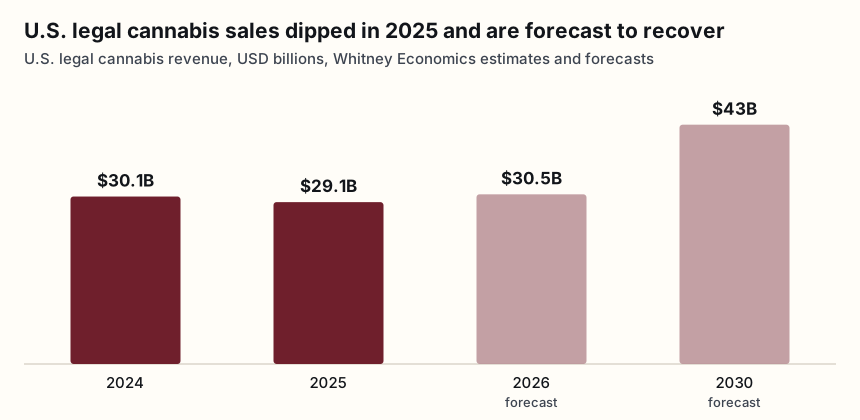
U.S. legal cannabis sales fell for the first time in 2025, to about $29.1 billion from $30.1 billion, because prices dropped while unit volumes rose. Whitney Economics forecasts $30.5 billion for 2026. Deal activity continues, but buyers pay mostly in stock, notes, and assumed debt, and value concentrates in limited-license states and low-cost operators.
Key takeaways
- Whitney Economics put 2025 U.S. legal cannabis revenue at $29.1 billion, down from $30.1 billion in 2024, and in March 2026 forecast $30.5 billion for 2026, a 4.9% increase.
- Headset's data for 16 states in the 12 months to June 2026 shows dollars up 0.8% while units rose 5.5%, with packaged flower down 5.7% per gram year over year.
- In 2025 California sales fell about 7% to $3.97 billion and Michigan fell about 3% to about $3.18 billion, while New York reached about $1.6 billion and Ohio passed $1 billion in its first full adult-use year.
- Viridian Capital data put cash at under 2% of disclosed cannabis deal consideration in 2025 and debt at about 94.8% of capital raised by U.S. licensed operators.
- As of mid-September 2026 only state-licensed medical marijuana is in Schedule III; adult-use remains Schedule I and subject to 280E, and SAFE Banking has been introduced but not enacted.
How big is the U.S. legal cannabis market in 2026?
About $29 to $31 billion a year, and no longer growing quickly. Whitney Economics measured 2025 legal revenue at $29.1 billion, down from $30.1 billion in 2024, the first annual decline since adult-use sales began in 2014. In March 2026 the firm forecast $30.5 billion for 2026, up 4.9%, and said single-digit growth would be normal from here. Its earlier forecast for 2026 had been 13.4% growth.
Estimates differ between research firms because they count differently, so treat any single national figure as an estimate with a method behind it, not a census.
| Measure | Figure | Period | Source |
|---|---|---|---|
| U.S. legal revenue | $30.1 billion | 2024 | Whitney Economics |
| U.S. legal revenue | $29.1 billion | 2025 | Whitney Economics |
| U.S. legal revenue, forecast | $30.5 billion | 2026 | Whitney Economics, March 2026 |
| U.S. legal revenue, forecast | About $43 billion | 2030 | Vangst and Whitney Economics, 2026 |
| Retail sales in 16 tracked states | $24.3 billion | 12 months to June 2026 | Headset |
| Industry jobs | 412,500 full-time | 2025 | Vangst and Whitney Economics |
The same jobs report attributes the 2025 dip to oversupply pushing wholesale prices down, not to weaker demand.
Why are sales flat when more product is being sold?
Because price is falling almost as fast as volume is rising. Headset’s retail data for the 12 months ending June 2026, covering 16 states, shows the pattern clearly:
| Metric | Value | Change year over year |
|---|---|---|
| Dollar sales | $24.3 billion | Up 0.8% |
| Units sold | 1.42 billion items | Up 5.5% |
| Transactions | 473.8 million | Up 6.5% |
| Packaged flower price per gram | Not stated | Down 5.7% |
| Average item price, June 2026 | $15.91 | Not stated |
| Average basket | $47.29 | Down 5.5% |
| Average discount | 26.0% of shelf value | Up from 22.8% |
More customers, more trips, lower prices, and about a quarter of shelf value given away in discounts. For an owner, that means a store can be busier than ever and show flat revenue. For a buyer, it means trailing revenue overstates next year unless the price trend is built into the model.
Whitney Economics told Shanken News Daily in July 2026 that prices in maturing markets have been falling 10 to 20% a year and that Arizona prices are down about 35% since adult-use sales began in 2021. It counted 24 states with declining revenue in 2025 and 15 with growth. In 2020 the split was 5 declining and 30 growing.
At wholesale, the national Cannabis Benchmarks U.S. Spot Index was $1,088 per pound on 4 September 2026. State prices sit far from that average in both directions, which is why cost per pound and margin benchmarks have to be read state by state. How falling prices feed into what a buyer will pay is covered in how oversupply and price compression affect value.
Which product categories are growing?
Pre-rolls and beverages are growing; flower and concentrates are shrinking in dollar terms. Headset’s category data for the 12 months to June 2026:
| Category | Sales | Share | Change year over year |
|---|---|---|---|
| Flower | $9.6 billion | 39.4% | Down 0.7% |
| Vapor pens | $6.15 billion | 25.3% | Up 0.8% |
| Pre-rolls | $3.84 billion | 15.8% | Up 10.1% |
| Edibles | $2.91 billion | 11.9% | Up 0.3% |
| Concentrates | $1.23 billion | 5.0% | Down 7.7% |
| Beverages | $289 million | 1.2% | Up 7.8% |
The shift matters for acquisitions. A manufacturer built around concentrates is selling into a declining category, while pre-roll capacity is in demand. Category mix is one of the first things a buyer checks in a manufacturer’s track-and-trace sales reports; see manufacturing and extraction valuation.
Which state markets are growing and which are shrinking?
Mature open-license states are shrinking in dollars, and newer markets still opening stores are growing. Full-year 2025 figures compiled by CRB Monitor in January 2026:
| State | 2025 sales | Against 2024 | What is happening |
|---|---|---|---|
| California | $3.97 billion | Down about 7% | Largest market, still contracting; high taxes and local bans |
| Michigan | About $3.18 billion | Down about 3% | Record volume at very low prices; figure from the regulator’s cumulative sales data |
| Massachusetts | $1.65 billion | Flat, a record | Neighbouring states now compete for the same customers |
| New York | About $1.6 billion | Growing | Store count still rising |
| Ohio | About $1.07 billion | First full adult-use year | $836 million adult-use plus $233 million medical |
Headset ranked New York the fastest-growing state it tracks, up 34.2% in the 12 months to June 2026, and California the largest, down 3.6%.
Michigan shows what high volume at low prices looks like. Cannabis Regulatory Agency data for August 2026 showed about $258.8 million of monthly adult-use sales, down from $282.8 million a year earlier, at an average retail flower price of $60.33 an ounce, close to the lowest on record. Oklahoma shows what happens after the shake-out begins: 1,735 active growers on 1 September 2026, down from a peak of 9,402 in December 2021, and 1,295 dispensaries, down from 2,611 in November 2023.
New adult-use markets opened in 2025 in Delaware (August) and Minnesota (September), according to the same CRB Monitor review. New markets are where revenue growth will come from over the next few years. They are also where prices are highest today and where compression has not yet arrived. The structural difference between the two groups is explained in limited-license vs open-market states.
What is happening in cannabis M&A?
Deals are getting done, but mostly without cash and increasingly out of public view. Viridian Capital data reported by Forbes in January 2026 put cash at under 2% of disclosed cannabis deal consideration in 2025.
Recent transactions illustrate the pattern. Companies are named here only because the terms are in press releases or filings.
| Date | Transaction | Terms disclosed |
|---|---|---|
| 16 December 2025, closed 7 August 2026 | Vireo Growth buys the assets of PharmaCann’s 17 Colorado dispensaries | Vireo shares valued at $49.0 million plus assumed liabilities, subject to inventory and payables adjustments; an asset carve-out of leased stores, not a company sale (closing release) |
| 27 July 2026 | Vireo Growth agrees to acquire Planet 13 Holdings | All stock: 0.015383618 Vireo share per Planet 13 share, a 16.6% premium to the 20-day average price; operations in Nevada, Illinois, and Florida |
| 11 August 2026 | Curaleaf announces a take-over bid for Canadian producer Aurora Cannabis | Implied US$4.00 per Aurora share, mostly in Curaleaf shares with a small cash component; an international, not U.S. state-market, deal |
Illustrative arithmetic on the Colorado deal: $49.0 million of shares for 17 leased stores is about $2.9 million per store before the assumed liabilities, in an open-license state. That is a useful reality check for a single-store owner whose price expectation was set in 2021.
Three themes run through current deal flow:
- Consolidation by a few acquirers with usable stock. Most public operators trade at low multiples. Viridian put the median for larger U.S. operators at 5.1 times estimated 2026 EBITDA in November 2025. That caps what they can pay without diluting themselves. See MSOs and consolidation.
- Carve-outs and retreats. Operators are selling individual state businesses to fix balance sheets, which puts real assets on the market in specific states.
- Distress. The CRB Monitor review lists 2025 receiverships and restructurings at Gold Flora, 4Front, and Ayr Wellness. Because plant-touching companies generally cannot use federal bankruptcy, these run through state receiverships and creditor-led sales, covered in cannabis receivership sales explained.
Small private sales follow a different pattern from public deals: a local or regional buyer, cash down plus a seller note, and a price set on verified after-tax cash flow. Whether public-company paper is worth taking is covered in selling for MSO stock.
Where is the capital coming from?
Almost entirely from lenders, and at high rates. The Viridian Cannabis Deal Tracker, as reported by MJBizDaily, put debt at about 94.8% of capital raised by U.S. licensed cannabis businesses in 2025. Equity investors have largely stepped back while share prices are low and federal reform is unresolved.
SBA loans remain unavailable under SOP 50 10 8, and banks do not make acquisition loans to plant-touching businesses. For a buyer of a single business this leaves personal funds, a seller note, and private investors; see cannabis acquisition financing options. For a seller it means the pool of buyers who can pay mostly in cash is small, and being willing to carry a note widens it.
What could federal policy change, and when?
Less than headlines suggest, and not on a known date. The position as of mid-September 2026:
| Issue | Status | Practical effect |
|---|---|---|
| Medical marijuana scheduling | State-licensed medical marijuana placed in Schedule III by order published 28 April 2026 | Qualifying medical activity is outside 280E going forward; dual operators must apportion |
| Adult-use scheduling | Still Schedule I. DEA hearing ran 29 June to 15 July 2026; no recommendation or final rule yet | 280E still applies to adult-use income |
| Banking | SAFE Banking Act of 2026 (S.4942, H.R.9471) introduced June 2026, not enacted | No change to bank or SBA lending |
| Hemp | P.L. 119-37 narrows the hemp definition. Cannabinoids the plant cannot naturally produce lose hemp status on 12 November 2026; the total-THC test, container cap, and converted-cannabinoid exclusion were delayed to 11 December 2026 | Most intoxicating hemp products leave the federal hemp market, which may shift some demand to licensed stores |
Details and sources are on rescheduling status and what it changes and intoxicating hemp products: regulatory status. The tax arithmetic for each outcome is on rescheduling tax scenarios.
The point for deal-making is that none of these changes creates value on a schedule. A broader move to Schedule III would raise after-tax cash flow for adult-use operators. It would also invite new capital and new competitors, and it would not fix oversupply.
What the outlook means for sellers
- Price expectations should come from current-year, after-tax cash flow in your state, not from 2021 offers or national revenue multiples.
- In contracting states, time is not on the side of a marginal operator. Each year of 10 to 20% price declines lowers trailing earnings, and buyers price on the trend. See selling in an oversupplied market.
- In limited-license and newly opened states, scarcity still commands a premium, and it tends to narrow as more stores open.
- Expect structure. With cash under 2% of disclosed deal value in 2025, offers will include notes, stock, or earn-outs, and the quality of the security matters as much as the price.
- Dual medical and adult-use operators should separate the two in their books now, because the medical share has a different tax position since April 2026.
- The timing question is addressed directly in selling before or after rescheduling.
What the outlook means for buyers
- Fewer funded competitors means more negotiating room, especially on seller financing and transition terms.
- Underwrite to falling prices. Re-run the target’s last 12 months at today’s prices, then at 10% lower, before settling on a number.
- Favour businesses that are low-cost in their state or protected by a license cap or local limit. The investment case is weighed on is a cannabis business a good investment.
- Distress creates openings, with two gatekeepers, a court and a regulator; see buying a license out of receivership.
- Do not pay in advance for federal reform. If it arrives, it is upside.
A broker will typically start with the specific state’s monthly regulator data and the business’s own records, not national figures, and that is a reasonable first topic for a free 20-minute intro call. This report is general education, not investment, legal, or tax advice, and forecasts cited here are the named firms’ estimates, not predictions by this site.
Frequently asked questions
Is the U.S. cannabis industry growing or shrinking in 2026?
Both, depending on the measure. Consumers are buying more units, and Headset counted 6.5 percent more transactions in the year to June 2026. But prices keep falling, so dollar sales are roughly flat. Whitney Economics measured the first national revenue decline in 2025 and expects single-digit growth from 2026, driven by newer markets such as New York and Ohio.
Which state cannabis markets are growing fastest?
Newer markets that are still opening stores. Headset ranked New York as the fastest growing of the 16 states it tracks, up 34.2 percent in the 12 months to June 2026. Ohio passed 1 billion dollars in combined sales in 2025, its first full adult-use year. Delaware and Minnesota began adult-use sales in 2025 and are still building out retail.
Why did cannabis sales fall in 2025 if more people are buying?
Because revenue is price times volume, and price fell faster than volume grew. Whitney Economics attributed the 2025 decline to supply saturation and price compression, not weaker demand. Its analysis describes prices in maturing markets falling 10 to 20 percent a year, which means a store can serve more customers and still report lower sales.
Are multi-state operators still buying cannabis businesses?
Yes, selectively, and rarely for cash. Recent examples include Vireo Growth's July 2026 all-stock agreement to acquire Planet 13 and its purchase of 17 Colorado dispensaries for 49.0 million dollars of shares plus assumed liabilities, signed in December 2025 and closed in August 2026. Large operators favour limited-license states and deals that add scale without new borrowing. Small private sales are more often funded with buyer cash and a seller note.
Will federal rescheduling raise cannabis business values in 2026?
It already changed the tax position of state-licensed medical activity, which moved to Schedule III in April 2026. Adult-use marijuana is still in Schedule I, the DEA hearing ended in July 2026, and no recommendation or final rule had issued by mid-September. Buyers generally will not pay today for a tax change that has not happened.
How often do the figures in a cannabis market report go out of date?
Quickly. State regulators publish sales monthly, wholesale indexes move weekly, and license counts change with every enforcement sweep or new round. Every figure here carries its date. For a valuation or an offer, use the current month's regulator data for the specific state and the business's own track-and-trace reports, not national annual numbers.
Sources
- Whitney Economics — Whitney Economics Forecasts U.S. Cannabis Growth to Resume in 2026 (24 March 2026) — https://whitneyeconomics.com/press-detail/whitney-economics-forecasts-u.s.-cannabis-growth-to-resume-in-2026-%C2%A0
- NORML — Analysis: State-Legal Cannabis Sales Exceed $29B in 2025, citing Vangst and Whitney Economics Jobs Report 2026 (25 June 2026) — https://norml.org/news/2026/06/25/analysis-state-legal-cannabis-sales-held-firm-in-2025-exceeding-29-billion
- Shanken News Daily — Price Compression Predictable and Inevitable, Whitney Says (14 July 2026) — https://www.shankennewsdaily.com/2026/07/14/40217/price-compression-predictable-and-inevitable-whitney-says/
- Headset — Cannabis Industry Statistics, 12 months ending June 2026 (updated 5 July 2026) — https://www.headset.io/data/cannabis-industry-statistics
- CRB Monitor News — 2025 Cannabis Market Review (January 2026) — https://news.crbmonitor.com/2026/01/2025-cannabis-market-review/
- Michigan Cannabis Regulatory Agency — Monthly Report, August 2026 (Statistical Reports) — https://www.michigan.gov/cra/resources/cannabis-regulatory-agency-licensing-reports/cannabis-regulatory-agency-statistical-report
- Cannabis Benchmarks — U.S. Cannabis Spot Index (4 September 2026) — https://www.cannabisbenchmarks.com/reports/u-s-cannabis-spot-index-september-4-2026/
- Oklahoma Medical Marijuana Authority — Licensing and Tax Data (1 September 2026) — https://oklahoma.gov/omma/about/licensing-and-tax-data.html
- Forbes (Javier Hasse) — Cannabis M&A Didn't Vanish. It's Just Not Happening In Public, citing Viridian Capital (20 January 2026) — https://www.forbes.com/sites/javierhasse/2026/01/20/cannabis-ma-didnt-vanish-its-just-not-happening-in-public/
- MJBizDaily — Debt dominates cannabis capital raises as equity deals dry up (2026) — https://mjbizdaily.com/news/debt-dominates-cannabis-capital-raises-as-equity-deals-dry-up/615106/
- Vireo Growth Inc. — Form 8-K, Item 1.01 Asset Purchase Agreement with PharmaCann (16 Dec 2025) — https://www.sec.gov/Archives/edgar/data/1771706/000110465925123459/tm2533764d1_8k.htm
- Vireo Growth — Vireo Growth Receives Regulatory Approval and Completes Acquisition of PharmaCann Colorado Retail Assets (GlobeNewswire, 7 Aug 2026) — https://www.globenewswire.com/news-release/2026/08/07/3341027/0/en/vireo-growth-receives-regulatory-approval-and-completes-acquisition-of-pharmacann-colorado-retail-assets.html
- Highly Capitalized — Viridian Capital Advisors Reports Valuation Metrics for U.S. MSOs with Market Caps over $100M (18 Nov 2025) — https://highlycapitalized.com/viridian-capital-advisors-reports-valuation-metrics-for-u-s-msos-with-market-caps-100m/
- GlobeNewswire — Vireo Growth Inc. to Acquire Planet 13 Holdings Inc. (27 July 2026) — https://www.globenewswire.com/news-release/2026/07/27/3333351/0/en/Vireo-Growth-Inc-to-Acquire-Planet-13-Holdings-Inc.html
- Curaleaf Holdings — Curaleaf Announces Intention to Launch Take-Over Bid for Aurora Cannabis (11 August 2026) — https://ir.curaleaf.com/2026-08-11-Curaleaf-Announces-Intention-to-Launch-Take-Over-Bid-for-Aurora-Cannabis-to-Solidify-its-Position-as-the-Global-Cannabis-Industry-Leader